“Dedicated to finding effective solutions for bird mite infestations of humans and their environment, encouraging those afflicted, facilitating research and a better understanding of human parasitosis.”
Terminology & Definitions
Acariasis – The term used to describe an infestation by parasitic acaroid mites. The New England Journal of Medicine and other medical publications have documented human affliction from bird mites; some with scabies-like symptoms and dermatitis. Although humans are not considered the primary host, bird mites are opportunistic predators that will bite people and other animals when the host bird is no longer available.
Acaricide – A pesticide specifically used to control mites (and ticks). Many commonly obtained insecticides are NOT effective against mites; and this would include most pyrethrin based products. Since mites are not considered an insect, they are often harder to eradicate with traditional chemicals used for most bugs around the home. Most of the effective acaricides are also more harmful to humans and should be used cautiously. Research has also shown that mites can quickly become resistant to chemical treatment and so a variety of chemicals may be needed.
Acarologist – An entomologist who specializes in mites. Usually affiliated with a research university. They can be a resource for any captured mite samples; as they would be able to identify the species and provide other information.
Arthralgia – Defined as a dull ache or soreness involving the joints of the body, more commonly in the hips, knees or lower back. Arthralgia can sometimes occur in someone who has a long standing parasite infestation. It is known that parasites excrete waste products that are toxins in the human body. Some with a bird mite infestation for an extended period of time have complaints of arthralgia, fatigue, and other somatic complaints.
Dermatitis – A term which describes the skin’s reaction due to some type of irritant; in this case due to mite bites. Symptoms can include: raised, reddened papules (bumps similar to mosquito bites); often intense itching; rashes; flakey or calloused skin, and itchy lesions. These symptoms tend to be more dramatic when the encounter with mites first occurs. Sometimes it is mistakenly diagnosed as scabies. Unlike mosquito bites, mite bites tend to heal slowly, and it can be several days before the symptoms subside. Over time the body becomes acclimated to the mite bites and the reaction becomes less severe as the body produces antigens to counter them.
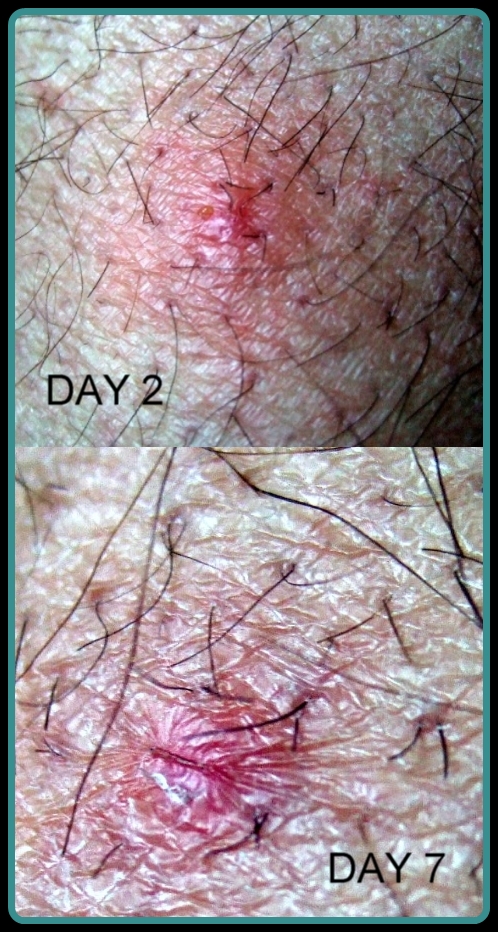
Close-up view of a bird mite lesion, with the raised, reddened center. By day seven, the inflammation has decreased, but is still somewhat noticeable. These bites often include irritation and intense itching.
Ectoparasite – A parasite that lives externally on the host. They survive on material on or below the skin; such as skin tissue, lymphatic fluid or blood. Parasitic bird mites are generally classified as an ectoparasite; but they can also enter the throat, lungs, ears, urethra, etc, of the host mammal. Since bird mites are good at burrowing, they can produce calloused, dermal bumps on the skin.
Endoparasite – A parasite that can survive internally in the host mammal, such as the scabies mite. Most acaroid mites are generally classified as ectoparasites, although some are also known to be endoparasites for at least part of their life cycle. For most people, a bird mite infestation would just be considered a skin parasite problem, but for some with a long-standing infestation there is the possibility of internal parasitism. Medical research has shown that acaroid mites are capable of living inside the human body, including the lungs, intestine, and urinary tract. Some manifestations of an internal parasite infestation include chronic fatigue, a sporadic cough, hypothyroidism, low body temperature, arthralgia, protracted yeast and fungal problems, and testing positive for Lyme disease.
Entomologist – Someone who researches and studies various insects species. They also classify the various insect species, and study their behavior and interaction with a host. As with other fields of study, there are inconsistencies among entomologists regarding the understanding of parasitic mites. There are some very informative entomology websites, usually affiliated with research universities. Entomologists do not study humans, and so most all of the information regarding human parasitosis and acariasis will come from the medical community. (That is why a person should question when an entomology website states empirically that bird mites do not survive in a human environment.)
IGR – Insect growth regulator. A non-toxic chemical that limits an insect’s ability to mature and reproduce. The early IGRs did not have much success against mites, but the newer products have become more effective. IGRs are often used in conjunction with a pesticide chemical, so that the ones that were not killed initially were further limited by the IGR. There are no IGRs specifically for bird mites, so other flea/tick products would be used, but with no guarantee of success.
Miticide – Another name for a chemical agent that is effective against mites (acaricide). Most knowledgeable PCOs use some type of miticide fumigant to eradicate mites in the home. Vikane gas, which is used for termites, is often the most effective treatment for eradication. Mites can hide in wall cavities and other places that make it nearly impossible to reach with traditional bug sprays. Some consumer products are effective against mites, but only with direct contact. They need to be applied thoroughly and frequently if the home is heavily infested. Also, it is important to vary the type of chemical occasionally, as they tend to become resistant to most things being used.
Morgellons – A disorder characterized by intense itching, open skin lesions that heal slowly, and strange fibers/filaments exuded from the skin. The person usually tests positive for Lyme Disease, even when there is no history of a deer tick bite. Brain fog and other neurological symptoms can occur. It is often contagious to others in the household. Many have reported the symptoms started after a skin parasite problem, and some have stated these were bird mites. This disorder is not well understood, but the mite parasite could possibly be a vector of some unknown pathogen in some people. The CDC has recently acknowledged this disorder and is currently doing research and accepting information from those afflicted.
One-year rule – A term that can be applied for those suffering from a long-standing bird mite infestation that has not abated. For those who have removed the source of the mites, have done everything else correctly, and are still bothered by bird mites a year latter, nothing else will logically explain it…the mites clearly have found a way to reproduce in the human environment, and human parasitosis and acariasis should be considered. There are those who have reported ongoing mite problems for many years, though not everyone will eventually have to deal with this. Early identification of the source as well as appropriate pest control measures are key.
PCO – The term used for a pest control operator. They can treat the home or office with chemical agents to eradicate nuisance bugs. They can use chemicals and equipment that the typical homeowner cannot obtain. They would be able to fumigate the home or building to eradicate bird mites. It is important to find one knowledgeable in bird mite infestation, as some are not. There are national chains and local companies capable of providing this service. Regardless of the treatment used, it is important that there be a follow-up one to two weeks later, to eradicate the previously unhatched mites.
Parasitosis – The term used to describe a condition of being afflicted with some kind of parasite. When medical personnel cannot verify the person’s claim of “crawling sensation on the skin”, they are often labeled as having ‘delusions of parasitosis’ or DOP. It tends to be an overused term by those unfamiliar with parasites or who may be unqualified to make a mental health diagnosis of psychosis. Since skin parasites are so small and illusive, it is often very hard to obtain a reliable sample. Immature mites tend to be much smaller than an adult mite, so high magnification is often necessary. (The term DOP came into favor in the 60’s, as drug addicts often suffered from this during withdrawals.)
If the individual is fortunate enough to find a physician who is willing to help ascertain the person’s claim of parasitosis, the following tests can be performed: Blood levels of IgE and IgG specific for mites/parasites and also checking eosinophil levels (WBC). Also, skin taping can be tried. This involves using a strip of clear shipping tape that is briefly applied to the infested skin and then examined under a microscope for mites. This tape exam has been shown to be effective even for scabies mites, when the examiner knows what to look for. There are reports that the mites will more easily show up under UV or black light when examined by someone knowledgeable. (Please keep in mind bird mites tend to hide and are more inactive during the day, and do not always reside in one area, as scabies mights do.) If mite parasitosis is confirmed by the physician, then a regimen of Bactrim, Septra, Flagyl, or a similar antibiotic could be initiated; as these medicines are effective against many types of parasites. Stromectal (oral Ivermectin) is sometimes prescribed, but has not been very effective to date.
Recommended Treatment Provider
We recommend you use a licensed professional to address a bird mite problem. Don’t wait or the problem will get much worse and more expensive to treat. We have a list of pest control companies that are specifically qualified to treat bird mites.
- They come to your house for no charge and give a free estimate.
- Even if you decide not to use them, you get free professional advice.
- Most pest control companies have never dealt with bird mites before. You need to use a bird mite specialist.
Follow this link to find a Qualified Local Exterminator near you.
Keep in mind that if bird mites are not treated correctly, even if the correct chemicals are used, they can become resistant to those chemicals. Don’t use a pest control company unless they have extensive experience treating bird mites.
Also, many of our readers have followed up with (or used outright) natural solutions and pesticide-free, such as on our Treatments Protocols page Follow this link to that page.
Natural and DIY Solutions
In addition to local exterminators, we offer a list of other natural, non-pesticide and/or do-it-yourself products that we have found helpful on our Treatments Protocol page. Follow this link to the Treatments Protocols page.